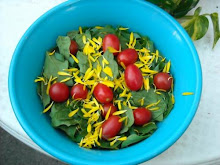
First Dr. McGrath, a plant pathologist from Cornell (and the reigning goddess of integrated pest management for fungal diseases), is quoted as saying if you see the new strain of downy mildew on your basil, it's best to just go ahead and make pesto NOW . . . and then Becky gets Japanese beetles! Poor basil.
Q. Hey, how do I keep Japanese beetles out of my basil?
A. You have two realistic options. 1). Don't plant basil, 2). Hand-pick and drown the little fuckers (um, the Japanese beetles, not the basil).
Two other possibilities. From a long-ago forum conversation over at davesgarden.com, I think: smoosh up a bunch of dead Japanese beetles. Add water. Strain and spray on plants. The jury is out on whether this works, and whether (if it does) it's due to the redistribution of pathogens specific to Japanese beetles, or if, as one forum poster put it "They come up and go OH NO it smells like Uncle Ed and then leave." And, from my own brain: find something that Japanese beetles like MORE than basil, and space it around your basil in pots so that they all go there. Then, either remove the pots (bugs with 'em) or hand-pick and keep using them. Actually, the basic concept isn't mine--it's called trap cropping, and works great with some bugs (e.g., supposedly, crucifer flea beetles). Problem is, I've never tried it (or heard of it being tried) with Japanese beetles, and also Japanese beetles like almost EVERYTHING. It's hard to tell what they'll go to and what they'll avoid. I've had them eat my marigolds but leave my rose bush alone (I know; WTH??), and I've had them do the opposite. :/ I'll do some research and get back to you on that one . . . . .
If you don't have a whole lot of basil plants (or feel like putting in a ton of effort), you could do tall row-covers-on-sticks. Make certain you've removed all beetles first, or they'll just happily munch away under the row covers. Bear in mind that this would not be a good first line of defense in the spring, though, since they hatch from grubs underground and come up wherever they please.
Okay, did a little research on trap crops. The internet says: African marigolds (they're the tall, skinny ones), borage (although, the poor borage!), evening primrose, and knotweed (I don't know if they mean the little pink-and-white flower that most gardeners refer to as knotweed, or the big-ass fuzzy plant that farmers tend to call by the same name. I would not advise intentionally introducing either . . . .).
The internet also informs me that interplanting with four o'clocks can a) attract and b) poison the beetles. I'm beginning to suspect that the internet is full of shit.
So, yeah. Sorry to be the bearer of bad news! A few last bits of info that may prove useful:
1. For long-term control, DO NOT use those yellow pheromone traps. They just attract extra bugs.
2. For long-term control, DO use milky spore. It kills the grubs. May take several years. If you have close neighbors with tasty plants and un-milky-spored lawns, the adults will probably wander in, though not in as great numbers as otherwise.
3. When hand-picking, go in early morning or late evening, when they're less active. Hold your container full of soapy water below the leaf or branch you're picking from, as a few bugs will almost always try the "drop off the leaf and you can't find me, ha ha" escape tactic.
Hope any of that helps!! The next time I have access to a) Japanese beetles and b) four o'clocks, I will monitor that and confirm/deny, and will also test out some trap crops. Until then, happy hand-picking!